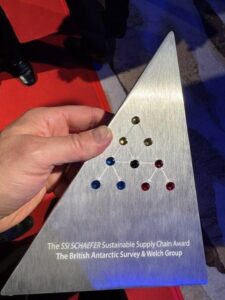
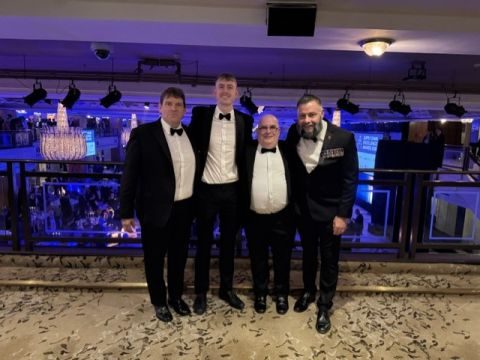
The winners were announced on Thursday 5 November at Grosvenor House in London, at the 30th and largest Supply Chain Excellence Awards, with more than 250 organisations competing across 30 categories. BAS also took home the Public Sector Supply Chain Excellence Award on the night.
For BAS, the two wins follow a Rising Star Award for its Warehouse and Storage Manager, Aaron Makinson, at last year’s awards. Simon Lancaster, Head of Supply Chain Logistics at BAS, summed it up on LinkedIn: ‘Three awards in two years.’
A supply chain on our doorstep
Just off the A14 at Bar Hill sits BAS’s Polar Distribution Hub, the warehouse that keeps British research going in Antarctica. It supplies research stations on the continent and the sub-Antarctic islands, a fleet of five aircraft, and the polar research ship RRS Sir David Attenborough. Simon calls it ‘quite a complex supply chain’.
Kit is packed and sealed at the hub, trucked to Harwich and loaded onto the ship. Every box must meet strict biosecurity rules, because introducing a non-native species to Antarctica breaches the Antarctic Treaty. And the weather always has the final say: a missed sailing can mean a research station going without kit for a season.
A few years ago, the UK end of this operation looked very different, with five warehouses, packing outsourced to Northampton and a tangle of truck movements between them. Simon described it as ‘an operation that was really built for yesterday’.
BAS rebuilt it around a single site at Bar Hill, rated BREEAM Excellent, solar powered and running on renewable electricity. It then set itself a target of net zero for its UK supply chain logistics within two years.
Twenty years on the road to Harwich
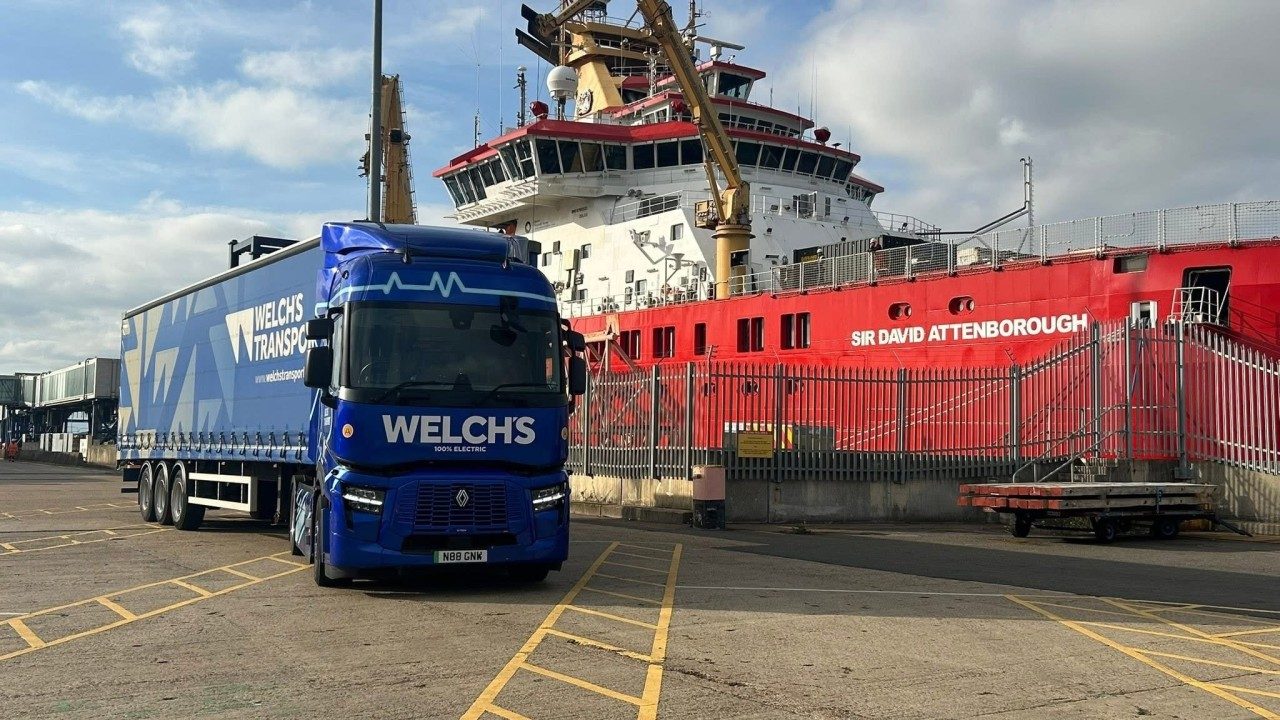
Welch Group has moved BAS cargo to Harwich for more than 20 years. When BAS went looking for ways to cut the emissions it doesn’t directly control, Welch’s had just taken delivery of its first 42-tonne electric articulated lorry. Simon’s reaction at the time: ‘Hang on a sec, there’s a great opportunity now through partnership.’
The early runs took careful planning, with charging fitted around loading and loading fitted around sailings. Simon admits both teams were ‘chewing nails’ on those first trips. But it worked. BAS moved all of its UK road transport onto electric trucks, and this season, in the run-up to the ship sailing, there were between 100 and 150 electric trips to Harwich and back.
With the trucks proven, BAS went further. It added an electric van between its Cambridge headquarters and the hub, standardised on electric forklifts across the UK and Antarctica, and brought in an electric container lifter.
‘The trucks were the proof,’ says Jamie Sands, Head of Solutions at Welch Group. ‘BAS’s own operation did most of the work.’
Net zero in two years
In the first year, carbon across BAS’s UK supply chain logistics fell by 49.3%. By the end of the second, BAS had hit its target: net zero for its UK transport emissions.
‘A special thank you to the Welch Group, with whom we’ve achieved net zero for our UK logistics operations this year,’ says Simon. ‘We’ve demonstrated how partnership and shared ambition can accelerate sustainability, create opportunities and support business growth.’
‘It’s a privilege getting people, equipment and supplies to some of the most remote places on earth, to enable our world-leading scientists to advance knowledge and understand an environment changing at extraordinary pace to help improve lives,’ he adds. ‘A modern, resilient and sustainable supply chain is fundamental to making that happen.’
Paul Dunn, BAS’s Head of Facilities, spoke alongside Simon at Welch Group’s Powering the Future of Freight event at Duxford, where Welch’s presented BAS with the Motor Transport award. He sees the partnership as being about what public money can do for the businesses and communities around it. For a public body, he said, it’s ‘more than giving somebody like Welch’s a purchase order to move freight to Harwich’.
Chris Welch, Managing Director of Welch Group, says: ‘We’ve been moving kit for BAS for more than two decades, so to share two awards with them in one year is something special. Their team set an ambitious target and hit it, and we’re proud our electric fleet played its part.’
What’s next
About half of BAS’s emissions come from its ship, which sails south on low-carbon fuel but returns on marine gas oil. Decarbonising that leg is the next big challenge, and one BAS is already working on.
For more information, see Jamie Sands’ article on the subject here.
Photo credits: British Antarctic Survey; Matthew Power Photography; Welch Group.