
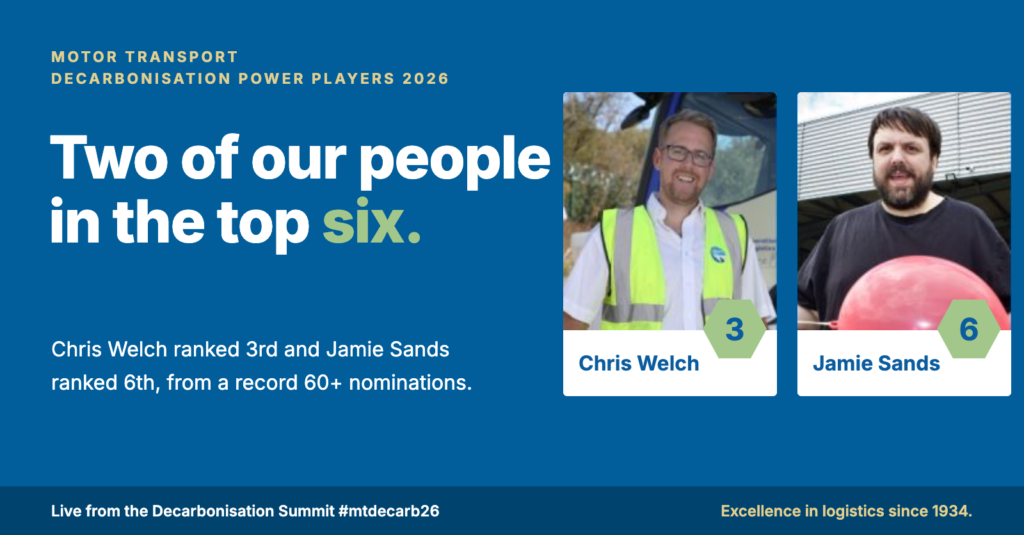
Two Welch Group leaders have been recognised among the people driving road freight’s transition to zero emissions, selected from a record 60+ nominations.
Welch Group is proud to announce that two of its people have been named in the top six of Motor Transport’s Decarbonisation Power Players 2026. Chris Welch, Managing Director of Welch’s Transport, is ranked 3rd. Jamie Sands, Founder of TwentyForty and Head of Solutions at Welch Group, is ranked 6th.
The list was revealed at the Motor Transport Decarbonisation Summit. Now in its fifth year, Power Players recognises the individuals leading the move to lower-carbon road freight. That includes deploying lower-emission vehicles, building infrastructure, advancing technology, shaping policy and sharing practical solutions. This year’s list was sponsored by Zenobē and the Road Haulage Association (RHA).
Chris Welch: from experimentation to acceleration
Motor Transport’s profile describes the past 12 months as a turning point for Welch’s Transport. After five years of testing, learning and working through the economics, the business has moved from trial to roll-out.
“In effect, in my head, we’ve cracked it,” Chris told Motor Transport. “We understand it. TCO modelling, infrastructure, buying vehicles. We’re on that roadmap now.”
Welch’s large-scale charging infrastructure at Duxford and Bedford is moving into operation. It has the capacity to support potentially 40% to 50% fleet electrification. By Christmas, the company expects to run eight electric trucks, around 12% of its fleet, with three 28-tonne electric Renault rigids on order. Chris believes Welch’s may have reached the point where it will never buy another diesel rigid.
The profile also highlights Welch’s approach to shared depot charging. Working with Corpay and Voltempo, the company is developing a system that will let external fleets book and use its chargers. “We’ve always shared diesel, so we were always going to share electric,” Chris said.
Shared charging could change the economics significantly:
- Using the infrastructure only for Welch’s own fleet would put its effective energy cost at around 40p/kWh.
- With 20 to 25 third-party charging sessions a day, Welch calculates that cost could fall below 25p/kWh.
- With much higher utilisation, it could eventually reach single figures.
That would turn charging infrastructure from an overhead into an asset. “If we can get to 9p/kWh, then you’ve just shaved two-thirds off your vehicle fuel costs,” Chris said. Welch’s currently spends around £6m a year on diesel. At those energy costs, Welch estimates an equivalent fully electric fleet would use around £2m of electricity.
Chris also has a clear message for smaller hauliers. “Any SME operator, in my eyes, can take one of their existing three-phase electric supply, upgrade it to a commando socket, get themselves 30kW or 40kW and run an electric rigid and not penalise themselves from an operational point of view.”
Jamie Sands: tackling the barriers beyond the vehicle
Jamie has already shown that battery-electric HGVs can work alongside diesel on the same jobs and customer commitments. His focus has now moved to the wider barriers that will decide whether electric trucks can be adopted at scale. These include grid connection queues, network capacity, land and lease arrangements, planning policy and uncertain residual values.
Jamie founded TwentyForty to tackle these issues across the whole system. Its work so far includes:
- publishing research into grid connection barriers using real network utilisation data
- running the Breaking the Barriers workshop series, which brings operators together with network operators, landlords and funders
- developing the 12 Pillars of Change framework, so the industry looks at the whole system rather than the truck in isolation
Jamie is clear: “The truck is no longer the hard part. Grid, property, energy and finance are. If we want the next wave of operators to electrify, that’s what we have to fix.”
As Motor Transport notes, the next wave of operators is unlikely to be held back by what the vehicles can do. The bigger risk is the infrastructure, property, energy and financial challenges around them.
Practical work, recognised
The recognition reflects the practical work behind Welch Group’s transition: getting electric HGVs on the road and putting the charging in place to run them.Congratulations to Chris and Jamie, and to everyone featured on this year’s list.
Read the full Motor Transport Decarbonisation Power Players 2026 supplement here.